what is total body enhancement at Planet Fitness; the question often arrives quietly, almost sheepishly, whispered between treadmills or typed into a search bar late at night. It begins the same way for many people: the hum of fluorescent lights, the faint scent of disinfectant and rubber mats, the muted bass of pop music leaking from overhead speakers. In the far corner of a Planet Fitness—America’s most ubiquitous gym chain—there’s a door washed in purple light. Inside, a machine hums softly, promising something more than sweat. Not transformation exactly. Something subtler. Something modern.
This is not a story about fitness alone. It is about how wellness has shifted from punishment to permission, from pain to possibility—and how a single machine came to embody that change.
The Room With the Violet Light
The Total Body Enhancement booth does not look like traditional exercise equipment. There are no plates, no pulleys, no mirrors demanding accountability. Instead, there is light—low-frequency red light—and vibration, delivered in a private, standing chamber that feels part spa, part science exhibit.
Planet Fitness introduced Total Body Enhancement as part of its Black Card membership, positioning it alongside massage chairs and hydro-massage beds. This context matters. Planet Fitness itself was founded on the rejection of gym intimidation culture, branding itself as the “Judgement Free Zone,” a phrase that has become inseparable from the company’s identity.
In that ethos, Total Body Enhancement makes sense. It asks nothing heroic of the user. You stand. You breathe.
Origins: From Medical Curiosity to Mall-Accessible Wellness
The technology behind Total Body Enhancement is rooted in red light therapy, a practice that did not begin in gyms at all. Low-level light therapy has been studied for decades, originally explored by NASA researchers investigating how light could promote wound healing in space.
Over time, red light therapy migrated into dermatology clinics, physical therapy offices, and wellness centers, often marketed for skin health, muscle recovery, and circulation. Medical institutions like the Mayo Clinic describe red light therapy as an emerging modality with ongoing research into its benefits and limitations
Planet Fitness did not invent science—but it did something arguably more influential. It democratized access.
By embedding this technology inside a $25-per-month gym membership, Planet Fitness reframed wellness tools once reserved for clinics and luxury spas as everyday amenities.
How It Works—Without the Sales Pitch
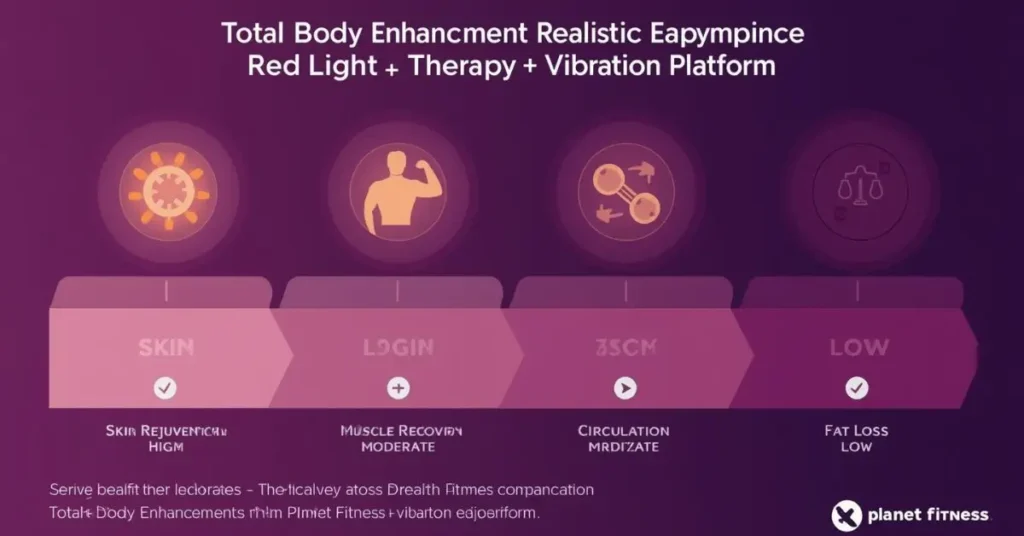
The Total Body Enhancement machine combines red LED light exposure with whole-body vibration. The user stands on a vibrating platform while red light panels surround the body. Sessions typically last about 12 minutes.
The red light operates at wavelengths believed to penetrate skin tissue, while vibration stimulates muscle fibers and circulation. Importantly, Planet Fitness does not market this as a medical treatment. It is framed as a wellness enhancement—a distinction that protects both the company and the user from inflated promises.
This restraint is notable in an industry often accused of overselling transformation.
The Cultural Meaning of Standing Still
In traditional fitness culture, effort is visible. Sweat validates worth. Pain earns progress. Total Body Enhancement disrupts that narrative.
Here, improvement is passive. You don’t push—you receive.
This shift mirrors a broader cultural movement toward recovery culture, where rest, regeneration, and nervous-system regulation are increasingly valued alongside strength and endurance. The rise of practices like yoga, meditation, and vibration therapy reflects a collective recalibration of what “healthy” looks like.
Planet Fitness, by design, serves people who may feel excluded by elite fitness environments. Total Body Enhancement becomes symbolic: wellness without performance anxiety.
Who Uses It—and Why
Spend enough time around the Total Body Enhancement room and patterns emerge.
There are older members seeking joint relief after cardio. Young professionals stopping in after long workdays. First-time gym users easing into movement without fear. Athletes using it as recovery rather than exertion.
What connects them is not vanity—it’s sustainability. People return to what doesn’t punish them.
Planet Fitness’ broader appeal lies in this psychology. By lowering emotional barriers to entry, it attracts demographics traditionally underserved by gym culture.
An Expert Perspective, Quietly Offered
On a weekday afternoon in a physical therapy clinic in the Midwest, sunlight filtering through blinds onto resistance bands and foam rollers, a licensed physical therapist reflected on the rise of consumer wellness technology.
Q: Is Total Body Enhancement medically proven?
A: The science is still developing. Red light therapy shows promise for circulation and muscle recovery, but it’s not a cure-all.
Q: Can it replace exercise?
A: No—and it shouldn’t try to. Think of it as complementary, not corrective.
Q: Why do people respond positively to it?
A: Because it feels good, and feeling good increases consistency. Consistency matters more than intensity.
Q: Any risks?
A: Minimal for most people, as long as expectations are realistic and safety guidelines are followed.
Q: Would you recommend it?
A: As part of a broader routine, yes. Especially for people intimidated by traditional gyms.
A Comparative Glance: Spa Luxury vs. Purple-Card Access
In high-end wellness resorts, red light therapy sessions can cost hundreds of dollars per month. These spaces emphasize exclusivity, quiet luxury, and clinical aesthetics.
Planet Fitness offers something else entirely: accessibility. The machine sits steps away from ellipticals and locker rooms, not curated candlelight. That proximity strips the practice of mystique—and that’s precisely the point.
Wellness here is not aspirational. It’s ordinary.
What It Is—and What It Isn’t
| Aspect | Total Body Enhancement at Planet Fitness |
| Purpose | Wellness support & recovery |
| Medical treatment | No |
| Effort required | Minimal |
| Accessibility | Included with Black Card |
| Cultural role | Stress reduction, consistency |
This clarity is refreshing in a market saturated with exaggerated claims.
FAQs
Is Total Body Enhancement safe?
For most healthy adults, yes. Users should follow posted guidelines and consult a professional if unsure.
How often can you use it?
Many members use it several times per week, depending on comfort and routine.
Does it help with weight loss?
Indirectly. It may support recovery and circulation but is not a fat-loss solution on its own.
Do you need protective eyewear?
Planet Fitness provides goggles to reduce light exposure to the eyes.
The Meaning of the Machine
Total Body Enhancement is not revolutionary technology. Its significance lies elsewhere—in what it says about who fitness is for now.
In a culture exhausted by optimization, this purple-lit booth offers a rare permission slip. To pause.
Planet Fitness understood something fundamental: that wellness is not only built through strain, but through relief. And in making that relief available to millions, it quietly reshaped the emotional landscape of the modern gym.
Conclusion: Light as a Language of Care
The question what is total body enhancement at Planet Fitness ultimately leads somewhere unexpected—not to muscle fibers or LEDs, but to identity.
It reflects a moment in time when Americans began redefining health as something gentler, more inclusive, and more sustainable. In the soft glow of red light, surrounded by the low hum of machinery, the body is not commanded—it is listened to.
And perhaps that is the future of fitness: not louder, harder, or faster—but kinder, quieter, and shared.
Read Also: Technology Hacks TGArchiveGaming: The New Frontier of Digital Play and Innovation