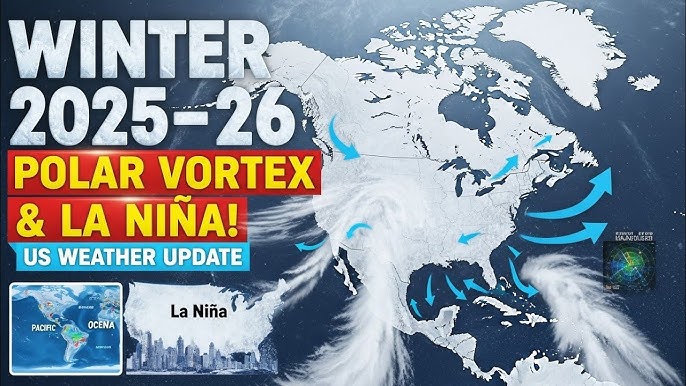
The La Niña polar vortex winter forecast is not just a prediction of cold and snow—it is a global climate story where cooling Pacific waters and restless Arctic winds decide how winter will be felt, remembered, and survived. The first breath of winter is like inhaling a crystalline secret: the air sharpens, the horizon bleeds cold light, and the world seems to pause. On some mornings, frost etches impossible lacework on windows; on others, a wind so cold it feels like history itself has turned against you. This is not just winter — it is a season of narrative tension, a drama written by giants: the Pacific Ocean’s mysterious La Niña and the swirling polar vortex above the Arctic. Together, they compose a climatic duet that shapes the lives of millions each year. Their interaction dictates not just mercury readings but cultural rhythms — snow-laden plains where harvest festivals once prayed for gentle frosts, northern towns holding lantern-lit winter carnivals, and farmers peering uneasily at their winter wheat. This season’s forecast is more than meteorological jargon — it’s a living saga of patterns and probabilities, of cold fronts that carve memory into bone and landscape alike.
The Cold Pulse: Origins, History, and Climate Oscillations
The term La Niña, Spanish for the little girl, emerged from fishermen’s descriptions of recurring ocean temperature cycles off the coast of South America. It was coined in contrast to El Niño (“the little boy”), a warming phase linked to idiosyncratic weather patterns. Together they form the El Niño–Southern Oscillation (ENSO), a Pacific heartbeat that swings roughly every 2–7 years, imprinting energy upon global atmospheric circulation. La Niña’s hallmark is cooler-than-average sea surface temperatures in the central and eastern equatorial Pacific, a condition that can ripple outward and reach far-flung winter skies thousands of miles away. National Weather Service
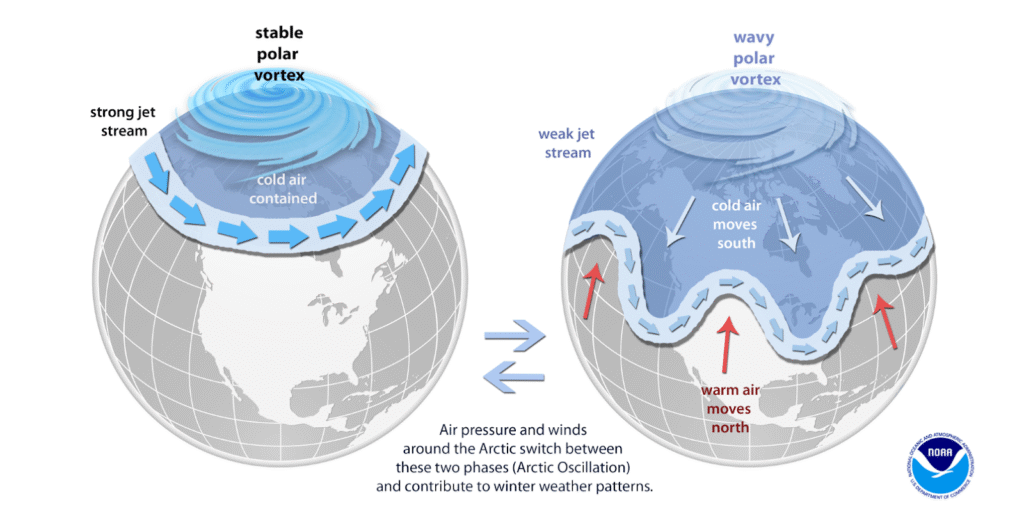
Yet even as scientists chart ENSO cycles with increasing precision, another player — the polar vortex — remains a wily, elusive force. Looming high in the stratosphere above the Arctic Circle, this vast, spinning pool of frigid air is typically locked away in its polar cage. But when that cage weakens — often due to shifts in stratospheric temperature gradients tied to broader climate teleconnections — the vortex can wobble, weaken, or even collapse (Sudden Stratospheric Warming), allowing bitter Arctic blasts to cascade into middle latitudes.
Together, La Niña and the polar vortex compose a narrative of winter’s ebb and flow — a story in which oceans whisper, jet streams buck, and continents shiver.
Modern Significance: Winter in the Age of Climate Complexity
Today’s winter forecasts are no longer simple barometer readings or quaint folk-weather lore. They are integrative assessments of global teleconnections — interactions between oceanic conditions and atmospheric dynamics that can amplify or dampen cold waves, storms, and precipitation regimes.
For winter 2025–2026, forecasters see a likely continuation of La Niña conditions, though weak, lasting through at least February. This matters because even a weak La Niña can influence the path of the jet stream, the high-altitude river of air that guides weather systems across continents. netweather.tv
Simultaneously, long-range models show an elevated probability of a weakened polar vortex — a state that makes it easier for cold Arctic air to spill southward into the United States, Canada, and parts of Europe. When these forces combine — even intermittently — winter becomes a stage for dramatic cold spells and heightened snowfall events.
In everyday terms, this means:
- Colder outbreaks might punctuate otherwise milder winter snaps.
- Snow-laden storms may shape travel woes and seasonal traditions alike.
- Agriculture and energy sectors must prepare for swings between mild and frigid episodes.
This interplay redefines winter not just as a season, but as a series of atmospheric negotiations between Pacific chill and Arctic strength.
Where the Cold Breath Falls: Geographic Patterns
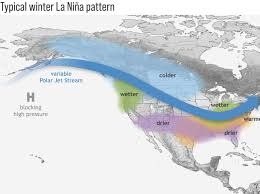
Here’s how these forces typically imprint regional winters, with a focus on North America and beyond:
| Region | Defining Features (La Niña + Polar Vortex) | Experience Type |
| Pacific Northwest (U.S. & Canada) | Colder temperatures, wetter conditions, heavy mountain snow | Alpine winter corridor |
| Northern Plains & Upper Midwest | Frequent cold outbreaks, increased snowfall | Classic snow belt |
| Northeast U.S. & Atlantic Canada | Potential for intense snowstorms, nor’easters | Coastal winter drama |
| Southern U.S. | Warmer, drier conditions during La Niña; sudden cold snaps with polar vortex events | Contrasting winter moods |
| Northern Europe | Disrupted jet stream → cold spells, snow anomalies | Old-world winter tales |
(This table synthesizes typical climatic tendencies under La Niña and a weak polar vortex influence as indicated by NOAA and seasonal forecast data.) The Economic Times
Compared to neutral or El Niño winters, La Niña-dominant seasons often manifest a wavelike jet stream that dips southward, ushering cold air into higher latitudes and mid-latitudes alike. The Weather Channel
Traditions of Winter: Cultural and Environmental Impact
For communities embedded in long, snowy winters — from Ojibwe winter festivals on frozen lakes to ski villages in the Rockies — these atmospheric patterns are cultural weather-makers. In Scandinavia, the onset of sustained cold and snow marks the opening of cross-country ski trails and the return of aurora lore. In rural Canada, ice fishing huts sprout across frozen lakes as families navigate long nights illuminated by northern lights.
Climate scientists emphasize that while global warming elevates average temperatures, mechanisms like La Niña and polar vortex disruptions can still produce extreme cold events even in a warming world. AP News
Remember the “Beast from the East” — a polar vortex disruption that slammed Europe in 2018, forging mythic cold and unforgettable community memories. These stories become part of local identity, woven into seasonal storytelling and winter rituals.
A Comparative Look: Winter Climate Traditions Worldwide
| Feature | La Niña / Polar Vortex Winter | El Niño Winter | Typical Northern European Winter | Eastern Asian Winter |
| Mood | Variable cold extremes | Warmer tendency | Steady cold | Monsoon transition influenced |
| Common Tools/Clothing | Heavy parkas, sleds | Light winter wear | Full winter gear | Layered insulated wear |
| Cultural Focus | Snow festivals, resilience folklore | Cozy retreats, mild festivals | Yule traditions, midwinter gatherings | Lunar New Year expectations |
| Main Appeal | Dramatic snow and storms | Gentle winter patterns | Crisp winter landscapes | Seasonal transitions |
This comparison underscores that winters — even when driven by similar forces — manifest various flavors worldwide, shaped by geography and cultural interpretation.
Expert Insights: An Interview Among the Snowflakes
On a crisp November morning at the National Weather Observatory in Boulder, Colorado, I sit across from Dr. Elena Royce, a senior atmospheric scientist and seasonal forecast specialist. Snow flutters outside like confetti, the Rockies crisp against a pale sky.
Q1: How do La Niña and the polar vortex interact to shape winter?
Dr. Royce: “La Niña alters tropical Pacific temperatures, which in turn shifts the jet stream’s path. When that pattern aligns with a weakened polar vortex — often due to stratospheric warming events — we get conditions favoring cold air surges into mid-latitudes. It’s a cascading effect rather than a simple cause-and-effect.”
Q2: Why do some La Niña winters feel mild while others are brutally cold?
Dr. Royce: “The strength of ENSO matters, yes, but so do other oscillations like the Arctic and North Atlantic Oscillations. Those can either amplify cold outbreaks or suppress them. Think of them as tuning knobs on winter’s climate dial.”
Q3: Can we predict polar vortex disruptions far in advance?
Dr. Royce: “We have models that suggest increased likelihoods, especially when La Niña combines with certain stratospheric wind phases like the Quasi-Biennial Oscillation (QBO). But exact timing remains challenging.”
Q4: What should communities prepare for this winter?
Dr. Royce: “Expect variability. Be ready for both mild spells and sharp cold surges. Infrastructure and emergency planning need to account for extremes.”
Her eyes drift to the windswept snow beyond the window — a reminder that uncertainty is winter’s oldest truth.
Practical Preparation & How to Weather the Season
Facing this winter’s mixed forecast:
- Stock Essentials Early: Heating, insulation, emergency kits.
- Monitor Local Forecasts: Jet stream shifts and polar vortex signals evolve quickly.
- Transit Preparedness: Snow tires, winter tires, public transit plans in cold snaps.
- Agricultural Readiness: Frost protection for crops and livestock winter shelters.
High-latitude residents are wise to plan not just for cold spells, but for rapid swings — the atmospheric equivalent of mood shifts.
Frequently Asked Questions
1. Is La Niña the same as a polar vortex?
No — La Niña refers to ocean temperature anomalies in the Pacific, while the polar vortex is a stratospheric circulation. Yet their interaction can influence winter severity. ПОГОДНИК
2. Does a weak polar vortex mean a colder winter?
Often, yes: a weakened vortex can let Arctic air push into mid-latitudes, increasing cold outbreaks.
3. Will La Niña guarantee a snowy winter?
Not necessarily — regional effects vary, and other climate patterns modulate snowfall and temperature. The Weather Network
4. How far in advance can these forecasts be trusted?
Seasonal forecasts offer probabilistic guidance, improving as winter approaches and models refine. netweather.tv
Takeaway: Winter’s Many Faces
This winter forecast is not a single prediction; it’s a tapestry of interacting forces — ocean chill, stratospheric dynamics, jet stream meanders. Together they paint a landscape where early snow may signal long cold snaps, yet bursts of mildness can punctuate the deep freeze. In this, we see not just a pattern of mercury readings, but a global climatic choreography with profound implications for ecosystems, communities, and culture.
Looking Ahead: The Future of Winter’s Story
As climate patterns evolve under human influence, the dance between La Niña and the polar vortex may become more unpredictable, creating winters that defy historical precedent even as they echo ancestral rhythms of cold and wonder. For those who watch, measure, and write about these seasons, the story continues — a narrative that is as elemental as snow on a windowpane and as sprawling as the jet stream itself.